Tuesday, September 25, 2007

The Great River Amazon Raft Race 2007


At noon last Tuesday I received an email: there was a raft race on the Amazon and a team needed an extra man. They were flying out the following morning at 5AM and I could step in if I could jump on fast enough.

Of course I jumped.


I flew to Iquitos the next day and crashed at the house of a team member for the night before starting what promised to be an adventure of epic proportions.

It is called the Great River Amazon Raft Race and brags about being the world's longest raft race at ~132 miles. The rules are simple: each 4 person team gets 8 logs and some jungle vines and makes their own rafts, then for 3 days they paddle down the Amazon River, stopping at a village called Porvenir the first night and a town called Tamshiyacu the second night.


View Larger Map

My team was Proyecto Dengue 1 (Project Dengue); it consisted of Amy, an entomologist who studies Dengue Fever and the mosquitos that spread it in affiliation with the US Navy and UCSD, Jackie, a grad student in entomology working with Amy, and Rod, a British physician who has been working on tuberculosis ventilation systems in Peru for a few years. Proyecto Dengue 2 consisted of 4 Peruvian field workers that work with Amy.

We collected big balsa logs from a boat then started whacking away at the ends of the logs with our little machete. Then a Mr. W, who lived across the river from the beach we were building the rafts on, showed up with an axe and offered to help us build our raft; after that he pretty much took over. Our unique design was to have a catamaran such that we could paddle in the center when paddling on the outside got tiring; Rod also very wisely thought to bring some lawn chairs, which we chopped down to size and then carved holes for and lashed them down in the back. I think it's fair to say that we had the most daring design.

Before the race even started, we had 2 people go to the hospital. One Australian gentleman who was in the race got stung by a stingray walking from the support boat to shore (the support boat was a double decker boat where we hung hammocks on the open top floor to sleep and below was storage); he needed to go to the hospital for anti venom. The second was a pretty British gal who had a nasty case of food poisoning.

Day 1: Saw what we thought was a kingfisher & lots of dolphins; the Amazon is one of the few places in the world with freshwater dolphins called Boto, some of which are a bright pink. We were thankful that it was cloudy, but I learned a lesson:
just because it's cloudy doesn't mean that the sun has gone away- the proof is that I burned the heck out of my feet, resulting in a fine "Irish suntan."
Overall spent about 7.5 hours rowing and we were all pretty hurting by the end. We stopped in the little village of Porvenir, which was basically a few community buildings surrounding a distillery where "Agua Arriente" or firewater was made from sugarcane- that stuff packs some punch I can tell you! We heard that another team had seen a poisonous water snake swimming along as well. It was great to get to know the stories of some of the international teams- there were representatives from at least Australia, the US, Canada, Mexico, Germany, Switzerland, Holland, and Tasmania (apologies if I'm forgetting some). There were the 4 funny guys from the US doing Peace Corps in Ecuador, the 4 Tasmanian river guides who said that this trip was as long as their entire island, the ringer team from Mexico-Germany-Canada-US who do competitive paddling and were clearly going to win for the international teams, the backpacker teams who met each other for the first time while building rafts, and others. It was relieving to hear from the Tasmanian river guides that the river was almost impossible to read and that they were going from competitive mode to enjoy the ride mode- made us feel better about ourselves, even though we finished a respectable 3rd place for the international teams on the day.

Day 2: This was the longest day at about 9.5 hours on the river. The coast guard actually had to go out looking for 2 late rafts after dark and so some towing. Now everybody knows that the Amazon River is long, but it really is an added challenge that it is so wide. In most places it seemed to be wider than the lakes I know from back in the US, and if I had to guess I'd bet that it was more than a half mile wide in most parts. This is frustrating because you have no point of reference to give you a sense of movement- you paddle for hours around these huge bends and can't tell if you're going forward or sideways or backwards. We were, luckily, able to take a somewhat narrower route in which the current seemed to move a bit faster and where the river was close enough that we felt we were trucking. We spent the night in the town of Tamshiyacu, where they had paved roads and the town actually put on a big performance with the school children in honor of us and then threw a party, which was great.

Day 3: We were all pretty tired by this point and the muscles were just feeling toasted. After 7 something hours, we reached the home stretch- an upstream paddle to the finish (the city of Iquitos is on a tributary of the Amazon River, which we had to paddle up). There were tons of local kids playing in the water to greet us (and snag a bit of a free ride) and a good turnout at the local boating house to see the end to this interesting endeavor. It was kind of abrupt to be leaving our little raft and the excellent company of Proyecto Dengue 1, but it was nice to give the arms and back a rest. It really hit me that the race was over when D, who was our support person and looked out for us, handed me a much appreciated cold beer.

This is one of those things you get to do once in your life, if you're lucky, and I feel very fortunate to have been a part of it.

Click on my photo below to go to my Picasa album, which has images linked to a map and high resolution photos.
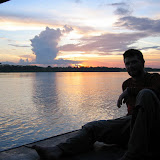
The Great River Amazon Raft Race 2007

Thursday, August 16, 2007

Quake aftermath


The aftermath:
7.9 quake
At least 337 Dead and the death toll might be much higher (e.g. 300 people were in a cathedral when it collapsed)
Supposedly 70% of a port city near the epicenter was leveled


It was on the front page of nytimes.com (this photo is from nytimes.com & I will take it down if asked)

http://www.nytimes.com/2007/08/16/world/americas/16cnd-peru.html?ex=1187928000&en=aca5b5d5be4d63cf&ei=5070&emc=eta1


Did you know that the west coast of South America (where Peru is) is the location of 2/3 of the world's large magnitude earthquakes?
So earthquakes are nothing new for Peru- who would have guessed it? There is an annual festival to commemorate a quake in 1746 when 5,000 people died (the Miracle Christ festival), and it is custom to wear purple in the month of October to commemorate the event.

This site has a great short history of quakes in Peru:
http://earthquake.usgs.gov/regional/world/peru/history.php

Wednesday, August 15, 2007

Quake in Lima

Today I was in my first earthquake, just 2 hours ago in the "gringo house" in Lima. The BBC says it was a 7.5 on the Richter.
Even more amazing, the phone company finally connected the internet in the gringo house!
But back to the quake.
It was strange but not at all scary. The house suddenly started shaking & the little wooden statue of an Incan playing a flute fell to the floor. The ground in the little square in front of the house undulated ever so slightly. The local people, or at least some of them, started panicking and one of them, a little old lady, clutched Gwen's arm and started speaking Spanish at a pace that would put the micro-machine commercial guy to shame.
A half hour or so later was an after-shock, and that was less strange because it was expected.
http://news.bbc.co.uk/2/hi/americas/6948888.stm
Anyhow, I'll try to fill out the story later, but for now I am heading out to drink Pisco (the local liquor, somewhere between sake & whisky) in the farewell party for a fellow gringo medical student.

Wednesday, June 13, 2007

Moyo

After spending the morning at the hospital in meetings for the project, Michelle and I took a walk to "Zoo Lake" and checked out a restaurant that Prof Dhai highly recommended. The park was nice, although I'm not totally sure that we were following all of the prohibitions listed in the sign. The food at Moyo was described as "modern African" and was excellent. Nothing too exotic but everything was delicious.


Sunday, June 10, 2007

Soweto

Today Michelle, Prof Ross & I took a tour of Soweto. The name "Soweto" takes the first two letters from "South Western Township"; it was set up as a temporary housing facility in 1904, housed migrant workers in large hostels in the 1940's, and has not changed substantially until the 1980's (electricity first was put in in 1985, and today many people still don't have it). Click here for the wiki on Soweto. The hostels were only made to house the working males, who would be away from their families for months, and so the structures to this day do not have indoor plumbing. Thankfully, they are being replaced by government-made housing.
Soweto has the reputation of being the place that the poor black people live; sometimes called "the heart and soul of South Africa," it is where the 1976 student uprising took place, where the Africa National Congress (ANC) party (the one formerly headed by Nelson Mandela and in power since 1994), and one of the squatter camps there is the home of the main character in the movie Tsotsi (Academy Award for best foreign film 2005).
Photos:
  1. Tuck Shop is a general store
  2. the tour company set up a preschool; they basically used a shipping container as the storage for the school
  3. ladies doing the wash; you can't see it, but there are also pirate electricity wires running from the power lines- when the authorities cut them, more are up by the next day- not very safe but you have to respect the inginuity
  4. tires along the road with Soweto in the background; during the anti-apartheid struggle, they had this thing called "tire necklaces"- when an informer on the anti-apartheid organizers was found, they put a tire over his/her neck, filled the tire with gasoline, then torched the person as a sign of what would happen to other informers
  5. the tour stopped in to see a soccer tournament that was being sponsored by the English Premier League team Manchester United; Wits U is here in yellow; our tour guide played soccer for many years and told us that soccer in South Africa was generally the black sport whereas rugby was historically the white sport; these days sports are integrated
  6. then we went to visit an unlicensed beer house & drink what the locals drink- homemade beer... it tasted rather sour
  7. our tour guide with some of the local kids; our guide is from and lives in Soweto himself
  8. a large wall painting inside of Regina Mundi in Soweto of Mandela, Tutu, Biko et. al.
  9. outside Regina Mundi Catholic church; this church was very important during the anti-apartheid era as a sanctuary and meeting place for all of the forces; go here for more of its history
  10. inside the church there are still bullet holes in the ceiling where soldiers shot both from outside the church into it and from within the church; our guide told us that they keep the bullet holes as evidence
  11. our host for the church tour shows us how the corner of the altar was cracked off when a soldier hit it with the butt of his rifle... the MAIN ALTAR IN THE FRONT OF THE CONGREGATION
  12. the famous Black Madonna, Our Lady of Soweto
  13. at a shanty town
  14. in the same shanty town; the remaining people are being moved into new houses that the government has constructed nearby
  15. the Hector Peterson memorial; Hector was a student killed in the June 16, 1976 by the police during a student demonstration about requiring Afrikaans to be a required language in schools; here is the wiki on Hector; one interesting thing I learned was that Hector's family had changed their name to one that sounded more white in the hopes that their children would be classified under apartheid as "colored" instead of "black;" while Hector was classified as "colored," his sister was "black;" there apparently was a committee that determined what your racial apartheid classification was based on your skin tone and hair (e.g. our guide said that for the "pencil test" they put a pencil in your hair- if it stayed you were black, if it fell you were not)
  16. Nelson Mandela's old house


Saturday, June 9, 2007

Apartheid Museum, wine tasting, ostrich fillet

When you arrive at the Apartheid Museum, they give you a pass- if you're colored you get one pass and if you're white you get another. You enter the museum through different entrances based on your color. As was intended, that went against my grain. The museum was a chronological exposition on the history of South Africa, how apartheid came into being, and how it was ended.
I thought the museum's presentations were balanced; they gave enough information to understand the conditions that led to apartheid and how the system persisted for so long (being dismantled completely only in 1994).
Below are some descriptions from the museum. Steve Biko is the person for whom the bioethics center I am doing research at was named for; he was killed because he was denied medical treatment as a prisoner after severe beatings. A photo of Desmund Tutu, Nobel Peace Prize winner, is also below.
After the museum, Michelle and I ran into our neighbor Carl, a Princeton student here putting together a camp to encourage high school students to go to college. We went to a nearby suburb to meet with some of his co-workers for a drink. We met CJ & Bruno, two MBA students at Cornell & Wharton, respectively, and decided to go to a wine tasting at a nearby Hilton. It was a very good wine tasting- the Shiraz's and Pinotage's were solid.
To cap off the night, we went to Mandela Square for a late meal. I had ostrich fillet- which is more like beef than chicken; it was excellent. However, this Mandela Square was conspicuously extravagant. Although I didn't get a pass, as in the Apartheid Museum, it is true that most of the country can not afford to come to a place like this. On Sunday Michelle and I will go with Eleanor on a tour of Soweto to see what is through the other door. Although the doors no longer have colors as labels, the new doors have income as the criteria.


Thursday, June 7, 2007

Holding pattern

The only thing to report is that my fellow research student from Harvard has arrived- Michelle. Besides that, we are waiting on ethics committee clearance from Harvard before we can begin talking to patients.
Here is a picture from the main library and another from the main campus quad of Wits.